

INTRODUCTION TO SAP TM
Transportation management involves planning, executing, and optimizing the movement of goods or people from one place to another. It plays a crucial role in supply chain management and can significantly impact efficiency, cost, and service quality.
SAP Transportation Management (SAP TM) is a comprehensive solution within the SAP ecosystem designed to manage and optimize transportation processes. It integrates with other SAP modules, such as SAP S/4HANA and SAP Event Management, to provide end-to-end visibility and control over transportation operations.
Key Features of SAP Transportation Management:

Transportation Planning and Optimization:
- Route Optimization: Calculates the most efficient routes considering factors like distance, time, and cost.
- Carrier Selection: Helps choose the best carriers based on service levels, cost, and performance.
- Load Planning: Optimizes the loading of goods to maximize space and reduce transportation costs.
Execution Management:
- Freight Order Management: Creates and manages freight orders and shipments, including coordination with carriers.
- Dispatching and Tracking: Monitors transportation activities in real-time and ensures timely execution of shipments.
- Delivery Management: Manages and tracks deliveries, providing visibility into shipment status and potential delays.
Integration:
- SAP S/4HANA Integration: Seamlessly integrates with SAP S/4HANA for real-time data sharing and operational efficiency.
- Third-Party Integrations: Connects with external systems and carriers for broader logistics management.
- SAP Event Management: Provides event-driven visibility and alerts for proactive issue resolution.
Freight Cost Management:
- Freight Cost Calculation: Computes transportation costs based on various factors such as distance, weight, and freight terms.
- Freight Settlement: Manages invoicing and payments to carriers, including dispute resolution and cost reconciliation.
Analytics and Reporting:
- Performance Metrics: Tracks and analyzes key performance indicators (KPIs) to evaluate transportation efficiency and effectiveness.
- Reporting Tools: Provides comprehensive reporting and dashboards for insights into transportation operations and costs.
Regulatory Compliance:
- Documentation Management: Handles required transportation documents such as bills of lading and customs declarations.
- Compliance Monitoring: Ensures adherence to regulatory requirements and industry standards.
User Experience:
- Fiori Interface: Utilizes SAP Fiori for a user-friendly, role-based interface that enhances usability and accessibility.
- Mobile Access: Supports mobile devices for on-the-go access and management of transportation activities.
Benefits of SAP Transportation Management:
- Improved Efficiency: Streamlines transportation processes and reduces manual effort through automation.
- Cost Savings: Optimizes routing, load planning, and carrier selection to reduce transportation costs.
- Enhanced Visibility: Provides real-time tracking and status updates for better decision-making and customer service.
- Better Compliance: Ensures adherence to regulations and standards, reducing the risk of non-compliance.
- Scalability: Adapts to changing business needs and scales with organizational growth.
Terminology used in SAP TM
- Freight Order: A freight order is a plan for the execution of a load or part of a load that arrives at a goods receipt office on a truck/land transport
- Freight Booking: A freight order is a plan for the execution of a load or part of a load that arrives at a goods receipt office on a ship/ocean transport
- Consignee: A consignee is the recipient of goods that are being shipped or transported
- Consignor: The consignor is the sender of a consignment
- Freight unit: The freight unit is the smallest unit that can be transported.
- Carrier: A carrier is a company or a firm or a person that is legally entitled to transport goods by air, water, and land
- Freight Agreement: You use freight agreements, along with calculation sheets, rates, and scales, to efficiently manage long-term contracts with your carriers.
- Freight Settlement Document: A freight settlement document is a document that is used for posting the freight cost accruals and that forms the basis of invoice verification in Materials Management (MM) for freight documents such as freight orders, freight bookings, and service orders.
Scenarios in SAP TM
There are two scenarios in SAP TM
- Shipper scenario
- Logistic Service Provider (LSP) scenario
Shipper scenario
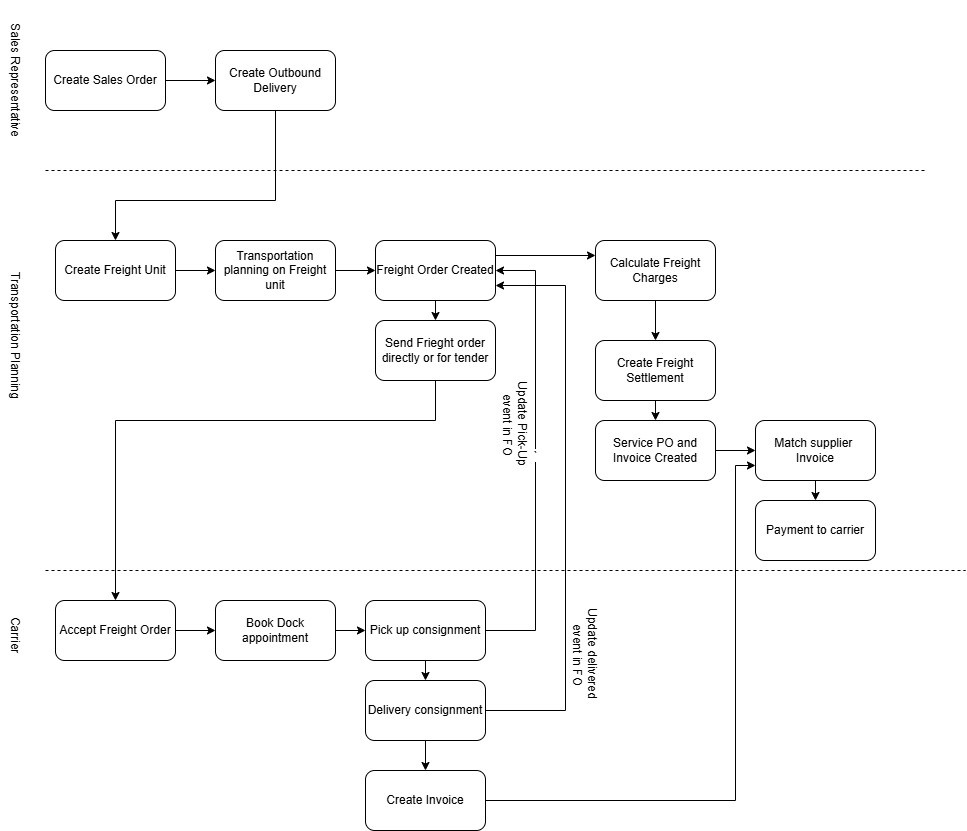
In this scenario a shipper creates a freight order/booking using TM. He requests LSP to deliver FO/FB. LSP receives the freight order and confirms the service. Later the settlement is done. In this case, TM is used by the shipper.
The scenario includes the following steps:
- Create sales order, delivery, and freight unit
- Freight order creation. FO should have the following determined automatically:
- Stages
- Carrier
- Step two can also be performed by using the direct shipment (create manually from freight unit) option or using an optimizer (freight order is created using the optimizer).
- Shipper send RFQ containing FO to carrier
- The carrier accepts the RFQ through LBN portal
- Shipper awards quotation to carrier
- The carrier confirms the quotation through LBN portal
- FO is executed (picked up and delivered)
- The freight settlement document is created along with auto service PO and service entry sheet
- Create Invoice from service PO—System Generated
- Carrier sends invoice
- Matching of Invoice from carrier and system-generated
- Invoice settlement.
Logistics Service Provider Scenario
In this scenario, the TM is used by a logistics service provider who provides services to a customer.
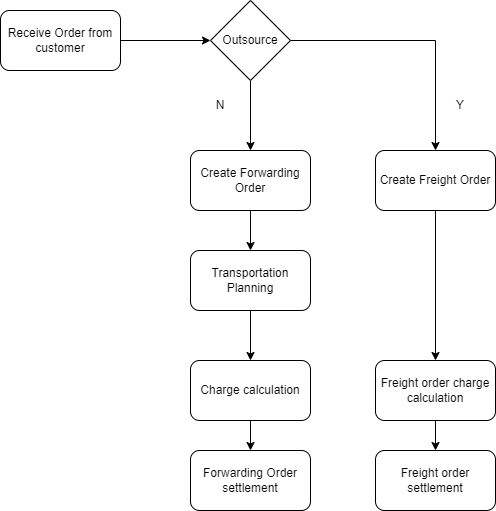
- In this scenario the LSP (like DHL) takes order from customer to transport goods
- A forwarding order is created for this purpose, which serves as an order from the customer.
- LSP uses this forwarding order to execute orders from customers. LSP can execute this order by himself or outsource the order.
- In case he wants to outsource, he will create a freight order based on the forwarding order and tender it to the subcontracting partner.
- In case he wants to execute the order by himself, the forwarding order settlement happens afterwards based on the forwarding order. In case he outsources, the freight settlement happens afterwards based on the freight order.
Next → Part 2- Organization Structure and configuration
All parts in the SAP TM series
- Part 1- Introduction and Terminology (you are here)
- Part 2- Organization Structure and configuration
- Part 3- TM Integration with SAP ERP Deliveries
- Part 4 - Setting Up Master Data
- Part 5 - Setting Up Resources and Schedules
- Part 6- Setting Up Document Types
- Part 7- Profiles in TM
- Part 8 - Using Optimizer for transportation planning(Creating Freight Orders/Bookings automatically)
- Part 9.1 - TM Freight Charge Calculation-Scales
- Part 9.2 - TM Freight Charge Calculation-Charge Type and Calculation Sheet
- Part 9.3 - TM Freight Charge Calculation-Testing Charge Calculation in FO
- Part 10 - TM Settlement Management
- Part 11 - EWM TM Integration


