
Before you touch a single EWM setting, you need a clear picture of how goods actually move through a business, and which SAP module takes care of each step. This first post in the SAP EWM series builds that picture.
Video walkthrough
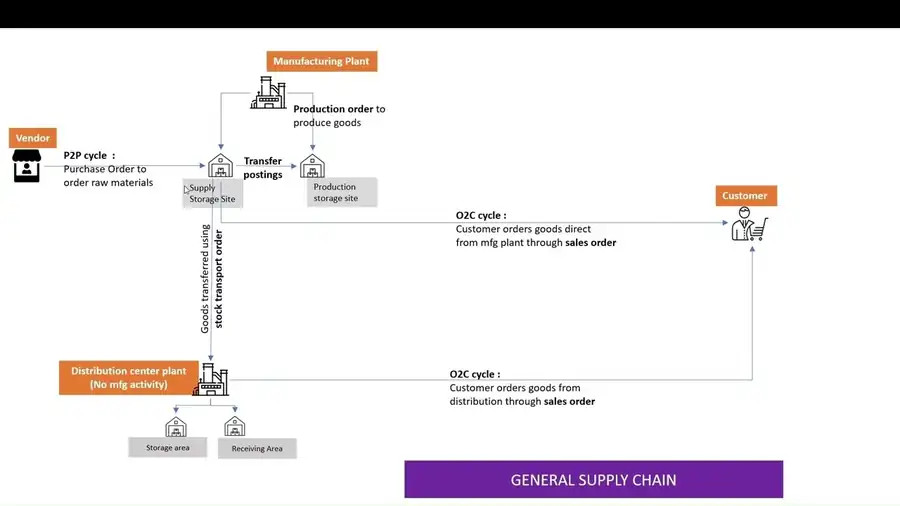
The general supply chain
Almost every manufacturing or trading company follows the same basic flow:
- Vendor → supply storage site (P2P cycle): the company raises a purchase order to buy raw materials, and the vendor delivers them to a storage site at the plant.
- Supply storage site → production storage site (transfer postings): raw materials are moved to the production area, where a production order converts them into finished goods.
- Manufacturing plant → distribution center (stock transport order): finished goods are shipped to a distribution center plant, which does no manufacturing. It only receives, stores and ships.
- Plant or distribution center → customer (O2C cycle): the customer places a sales order, and goods are shipped either directly from the manufacturing plant or from the distribution center.
Inside the distribution center there are physical zones, such as a receiving area and a storage area. Managing those zones is exactly where EWM comes in.
Which SAP module does what
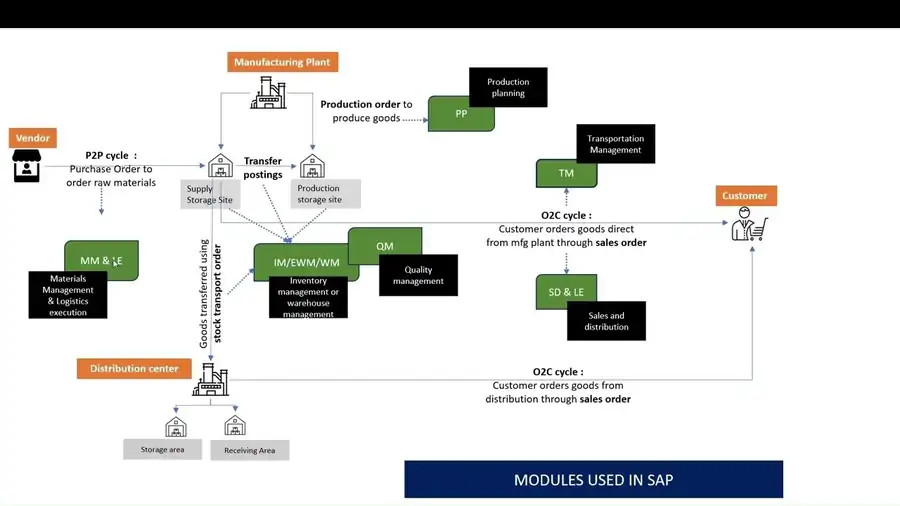
Each part of the flow is handled by a specific SAP module:
| Module | Full name | Role in the supply chain |
|---|---|---|
| MM & LE | Materials Management & Logistics Execution | Purchase orders, inbound and outbound deliveries |
| PP | Production Planning | Production orders that turn raw materials into finished goods |
| QM | Quality Management | Quality inspection of received and produced goods |
| IM / WM / EWM | Inventory / Warehouse / Extended Warehouse Management | Stock in storage locations and detailed warehouse operations |
| SD & LE | Sales and Distribution | Sales orders and customer deliveries |
| TM | Transportation Management | Planning and executing freight between sites and to customers |
Why this matters for EWM
EWM never works alone. A goods receipt in the warehouse starts with a purchase order in MM. A pick in the warehouse starts with a sales order in SD. A putaway to the production supply area is triggered by PP. If you understand these hand-offs, the EWM configuration in the next posts will make much more sense.
Key takeaways
- P2P brings goods in, production transforms them, stock transfers move them between sites, and O2C sends them to customers.
- EWM manages what happens inside the warehouse: receiving, storing, picking and shipping.
- MM, SD, PP, QM and TM all create documents that EWM executes.
Next in the series: EWM Introduction, covering what EWM is, deployment options, and what a warehouse looks like.
Next → SAP EWM Series 2: EWM Introduction – Deployment Options, Warehouse Layout and Processes
All parts in the SAP EWM series
- SAP EWM Series 1: How the Supply Chain Works in SAP ERP (you are here)
- SAP EWM Series 2: EWM Introduction – Deployment Options, Warehouse Layout and Processes
- SAP EWM Series 3: EWM Org Structure – Plants, Storage Locations, Warehouses and Availability Groups
- SAP EWM Series 4: ERP Delivery Types and Item Categories for EWM
- SAP EWM Series 5: EWM Document Types, Item Types and ERP Mapping
- SAP EWM Series 6: qRFC and Interface Settings for Embedded EWM